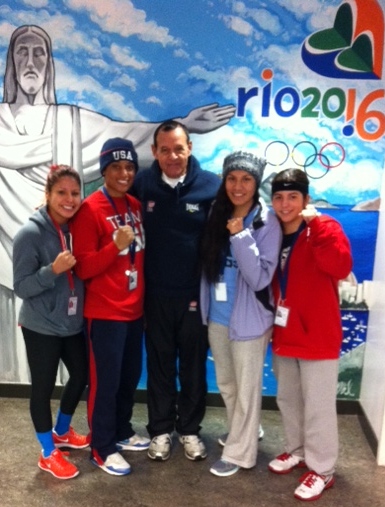
USA Women’s Boxing Is Now “Team Pedro”
By Raquel Ruiz
Pedro Roque Otano came aboard a ship that was ready to sink. It didn’t, largely because of the performance of the U.S. women boxers at the 2012 London Olympics.
Gold medalist Claressa Shields and bronze medalist Marlen Esparza prevented the U.S. from being shut out on the podium for the first time, after the U.S. dominated amateur boxing for much of the 20th century. So the boat continued afloat. But the world knew then that big change was needed.
The consensus among boxing fans, journalists, coaches and the most importantly, the boxers: no more politics at USA Boxing, which governs the amateur sport domestically. At the end, it is the fighters, male and female, who sacrifice themselves to compete in the sport they often love more than their lives.
But the message from the U.S. Olympic Committee was equally clear: no medals, no support. It’s a standard common all over the globe. Fans fretted over the future of the the U.S. Olympic boxing team, and the amateur game in general.
Finally, in September 2012 USA Boxing announced the hiring of a new National Coach, an outsider with a long history of building successful programs. The arrival of Coach Pedro Roque Otano, a Cuban and former AIBA coach of the decade, meant USA Boxing was finally serious about competing internationally, instead of merely serving as a minor league to the professional ranks.
But soon after Coach Pedro’s arrival at Colorado Springs at the National Training Center, the complaints, concerns and comments started coming in:[[MORE]]
Those were three of the main concerns. I was most occupied with the second. If Roque doesn’t support women’s boxing, he needed to go.
Soon after his hiring, Roque spoke with insideboxing.com and answered each of those concerns with apparent sincerity. But like all those following USA Boxing, I was tired of empty words. So I decided to wait and let his actions speak for themselves.
Six months later, I met Coach Roque at the 2013 USA Boxing Nationals in Spokane. If you’ve been around boxing enough, you understand it’s a big family. So I embraced the national coach with an open heart, while keeping my journalist’s instincts on guard.
Seven long days of conversation with this festive man showed me he had already brought his Latin flavor to the USA Boxing staff. The tension that journalists had felt before at the media table, it was gone. Pedro Roque Otano had engaged all around him with his passion for working hard and having fun. The change in the atmosphere surrounding the team was dramatic.
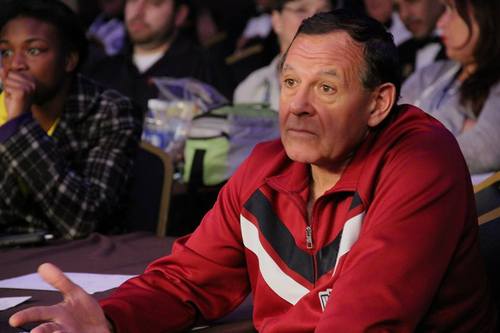
Speaking with Coach Roque is easy, not only because we share the Spanish language, but also an understanding that extends beyond words. Speaking to Coach Pedro, who I call now profe, short for “professor”, I realized this was a man that knew his subject inside and out.
From day one Coach Pedro answered all my questions, but I needed to hear more. So over the next seven days at Nationals, we engaged in a running exchange of opinions, observations, and points of view. Our ongoing conversation has lasted ten months now. When I write, I need more than words from my subjects.
Last week I saw profe again at the 2014 USA Boxing Elite Nationals in Spokane. His approach to the development of boxers remains very strict.
“They need to work hard, everyday. An Olympian needs to be prepared for six years,” he said.
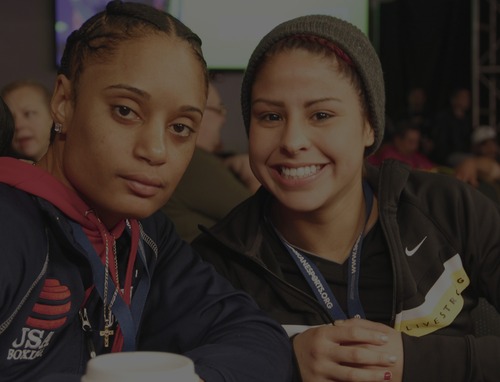
Two 2012 Olympians have been working with profe since last year. Queen Underwood (60 kg, left) and Marlen Esparza (51 kg, right) are in the residence program. They left the coziness of their families and homes to live at the Olympic Training Centre in Colorado Springs and train with profe everyday.
Everyone who attended Nationals or watched it via live Web streaming can testify to the improvement of these two fighters. Both claimed gold medals.
“We spent new years at the airport going to camp”, Esparza said.
“These two ruined my Christmas,” profe said, smiling at his two boxers.
Those who know Queen Underwood understand her trusting instincts are the key to her heart. And to see her so confident, and happy with her new coach was an omen to me.
As soon as Queen finished her bout against the gifted boxer Rashida Ellis, she looked around trying to find her coach.
“Where is Pedro”, she asked. And as soon as she saw him, a blissful & beaming smile lighted her visage.
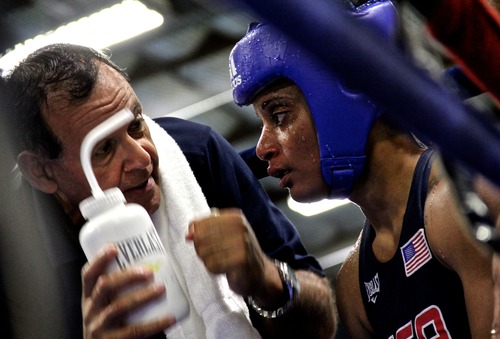
Throughout the tournament profe was taking notes and watching the boxers very closely. Sometimes at the end of a bout, he approached the boxers to congratulate them. I saw him talking with coaches, parents, all the easier with hardly any media present at the tournament.
Profe has a daughter and two granddaughters living in Canada. He misses them very much. He calls the women boxers his niñas. And he treats them like daughters, imparting structure, love and discipline.
“This is not a game, this is serious businees,” he told me in Spanish.
Profe hasn’t focused solely on the Elite women. He also sent the junior and youth female fighters to International competitions for the first time in the USA Boxing history.
Currently he has Caitlin Orosco (51kg) and Jajaira Gonzalez (60 kg) at the Olympic Center training with the Elite male team. Orosco and Gonzalez will stay in the Olympic Center for three months, then head to the AIBA Youth World Boxing Championships in Sofia, Bulgaria from April 10th to 25th. If either can finish among the top five in their divisions, it could spawn much greater opportunities, like traveling to China in August for the Olympic Youth Games.
These two boxers from Southern California won gold last September in Albena at the AIBA Women’s Junior & Youth World Championships. They were in the Junior division. In January 2014 at the USA Junior and Youth Open, both claimed national championships.
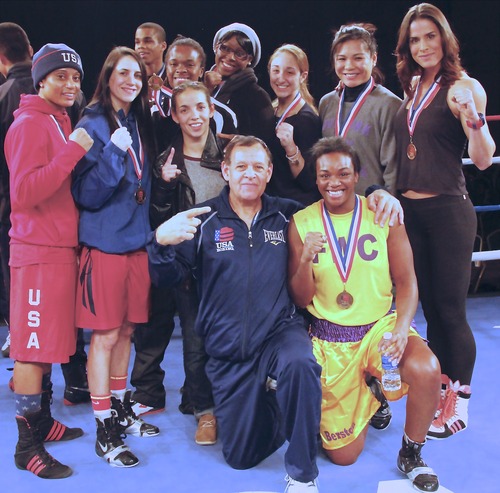
Since Coach Pedro joined up, USA Boxing has captured 35 gold, 16 silver and 24 bronze medals in international competitions, including both male and female fighters from Elite to Junior. The most golds came from the Elite women’s team last year in Venezuela at the Continental championships, where eight of the ten members were the champions.
During the Combat Sports Games in Russia last November, Queen Underwood defeated UK boxer Natasha Jonas in a rematch, after Jonas beat Queen in London. Marlen Esparza won silver in the same tournament.
The Elite women fighters in Olympic weight clases (there were only three in London) are getting ready to compete in Dominican Republic at the Independence Cup tournament, which runs from February 8-14. Unfortunately, Claressa Shields is injured and can’t assist in camp or compete.
But there were still the other two concerns about profe: his facility with English, and the fact he isn’t American.
2012 AIBA World Championships Bronze Medalist (64kgs) Mikaela Mayer doesn’t speak Spanish, but offered this last year: “I don’t understand why they are so concern about it. My coach Al Mitchell has a boxing camp in China and he doesn’t speak Chinese.”
We all know boxing is a universal language and USA Boxing has bilingual boxers throughout its ranks, as well as bilingual coaches. Knowledge lives in the mind. It needs to be fed by experience and practice, and profe has all of that. He has helped other countries win 35 Olympic medals, including 11 golds, along with 43 world championship medals.
In fact, many believe that hiring an outsider was a great move by USA Boxing. Profe is a coach not yet contaminated by internal politics, someone with a fresh approach who doesn’t have favorites. Still, several coaches in the U.S. had legitimate concerns.
I met with some of the most respected coaches and discussed those concerns. What I noticed in those conversations was the egos of those involved.
Since profe’s arrival in Colorado Springs, he has crafted a plan to elevate both the male and female boxers, and hosted several training camps. Last year after one of the camps, six female boxers between the ages of 14 and 15 went across the continent to compete at the Pirkka Tournament in Tampere, Finland. There were boxers from Russia, England, the U.K. and Finland in the tournament.
Five of the American fighters won Gold, the other took Silver. Some critics complained about taking a team across the ocean for a single bout, but the fighters felt differently.
One of those gold medalists was Nyjsa Barrientes, 16, from Las Vegas. She has been boxing for four years and takes AP classes as part of the 10th grade. She described her first international bout as very challenging.
“I was very nervous because I didn’t know what to expect, but after being in the ring and seeing I was not only at their level but better, it gave me a lot of confidence,” Barrientes said.
The female junior team was led by coach Mike Newson Jr. from Las Vegas. Newson has great respect for Otano’s approach. Newson has been coaching boxers for 11 years after a shoulder industry forced him to stop competing in Tae Kwon Do and Kick boxing.
“He gave me the opportunity to coach a team, based on what he saw at the camp,” Newson Jr., 35, said.
Profe could right now be working in France or in Miami, where he had juicy offers, but his heart has been taken by all the male and female boxers in the U.S.
Esparza, the most decorated amateur boxer in the country besides Shields, was once known for not wanting to go to camps with the team. Esparza is also perhaps the only amateur boxer in the country that competes at the Olympic level but still supports herself entirely through boxing. Now she is looking forward to the next one.
“For the first time in USA Boxing I am not pissed off at the coaching,” Esparza said.
Esparza is also one of the many fighters to embrace the #TeamPedro hashtag on Twitter. If you ask the fighters which team they are part of, they almost all respond with, “We are #TeamPedro.”
The road is long and profe knows that. But he also knows the gold medals will continue if USA Boxing keeps implementing his program and giving the fighters the international exposure they need. Not just at major international tournaments, but also the 2016 Olympics in Rio.
“Cuba learned from the U.S. about how to prepare boxers, but this country lost its North at some point and didn’t continue with the structures of training, camps and competition required to succeed,” Otano said.
“I came to help and support the work that hundreds of trainers do in the USA. I am only a small part of the system.”