USA Boxing Nationals Sans Headgear Are A Big Flop
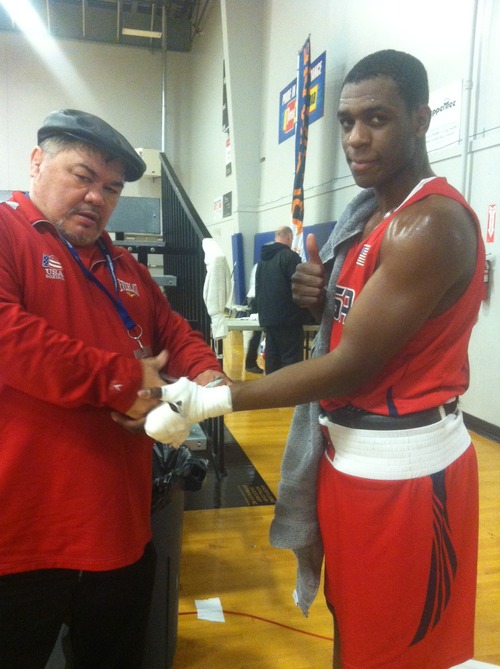
LeShawn Rodriguez and trainer Mike Murphy
By Sarah Deming
SPOKANE, Wash.–“It used to be standing room only at the Nationals,” said Coach Charles Leverette, gesturing to the cavernous HUB Center, where a few dozen boxers were warming up.
Attendance at the 2014 USA Boxing Elite National Championships is stunningly low this year: 178 boxers, 55 women and 123 men. The men’s super-heavyweight division has just four entrants.
Last year’s event, which included youth boxers, drew 477 athletes. Open-level male boxers could chose between an elite, headgear-free division and a senior, headgear division. The elite male division drew 184 athletes, and the senior division drew 92. In 2012, there were 718 boxers.
“The rule changes have impacted the numbers. A lot of men are deciding whether or not they want to compete without headgear,” Julie Goldsticker of USA Boxing said.[[MORE]]
Leverette is here in Spokane without the men’s side of his U.S. Army team. There’s no Air Force team, either. Armed forces higher-ups are still debating the wisdom of putting their soldiers in the ring without headgear, and we applaud their caution.
Several boxers were cut during preliminary bouts. Atlas Cops and Kids’ own Jose Delarosa lost a close fight to Ardeal Holmes of Flint, Michigan on Monday. Holmes was cut in the bout and had to go into the ring the next day to face national champion Jose Alday.
“They stitched it up,” said Holmes’ coach Jason Crutchfield, who also trains gold medalist Claressa Shields. “It looked good going in, but it opened again in the last round.”
We couldn’t find a single trainer who approved of the new rule.
“These are amateur boxers,” said Crutchfield. “They make a lot of mistakes, and the headgear is there to protect them. I saw two guys bump heads so hard they damn near knocked each other out.”
It remains to be seen whether the International Olympic Committee will allow bareheaded boxing at the 2016 Rio Games, and, if it does, what effect this will have on amateur boxing’s waning popularity. Judging by the numbers here in Spokane, the new rule has only hurt amateur boxing in America.
This is just the second year that the Nationals have been an open tournament. Any boxer is free to compete, as long as he has fought at least 21 bouts (five for women). Opening things up sounds like an inclusive move, but it may have hurt the grassroots. Prior to 2012, boxers had to qualify for the Nationals by winning their local and regional championships. Regions would fundraise to send their champions.
“Where is the elite component to this?” wondered Yvonne Williams, President of New York Metro, one of the few local boxing clubs that still has the resources to send a team.
Indeed, most of the preliminary round bouts were of novice level. The sole boxer to impress was middleweight LeShawn Rodriguez of Long Island, who showed both defense and power in his win over the tough Clinso Brumfield of Alexandria, Virginia.
Tiara Brown is the only Headbanger here. Her LBC President will work her corner while trainer Patrick Harris gets ready for the Lamont Peterson fight at D.C. Armory on Friday night.
Tiara shared the bittersweet news that Kareem Martin, Stiff Jab’s 2013 Amateur Boxer of the Year, just signed on with boxing’s top power broker Al Haymon. Yet another promising amateur prospect scooped up into the pros! It is hard to imagine a medal for the men in Rio, or to read the official press release for this week’s event without a pang:
“The USA Boxing National Championships began in 1888 and many of the greatest champions in the history of the sweet science got their start in the nation’s premier national championship event, including: Cassius Clay (later Muhammad Ali), Sugar Ray Leonard, Oscar de la Hoya, Floyd Mayweather, Jr., and Andre Ward.”
World Golden Gloves champion Earl Newman of New York offered another explanation for the disappointing numbers.
“Everyone is a little broke,” Newman observed. “They shouldn’t have had Nationals so soon after Christmas.”