The Night BHop & Big Daddy Bowe Brought Boxing to RFK Stadium
by Aaron Tallent Special to Stiff Jab
WASHINGTON, D.C.–Bernard Hopkins’ dominating win over Beibut Shumenov at D.C. Armory on April 19th was proof that Washington has re-emerged as a first-rate fight town. Almost 7,000 fans crowded the Armory to see Hopkins confirm his place as the top contender to light heavyweight champion Adonis Stevenson. The rise of Lamont Peterson is what brought the TV networks back to the nation’s capital, but BHop was first out-of-town fighter to headline here in almost a decade.
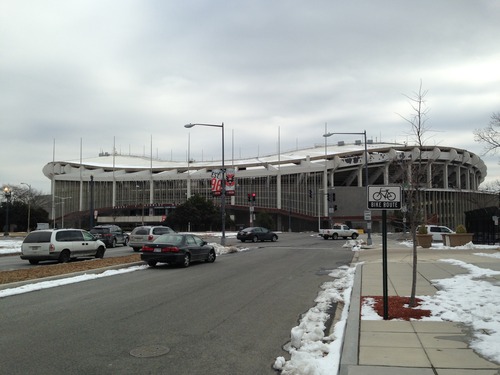
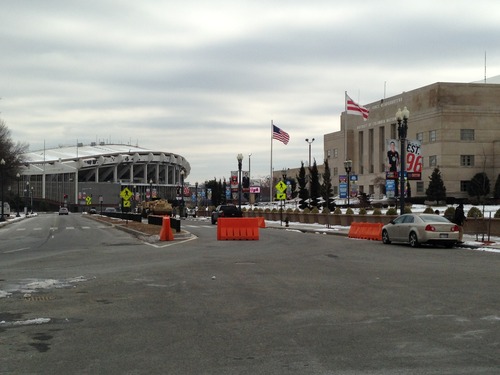
The irony is that Hopkins was there the last time D.C. hosted a huge fight when he faced Roy Jones Jr. in 1993 at Robert F. Kennedy Memorial (RFK) Stadium, just a stone’s throw away from the Armory. The story of that debacle is much less about Hopkins and Jones than it is about Riddick Bowe and his manager, Rock Newman.
Entering 1993, Bowe was flying high. He won the heavyweight title from Evander Holyfield in November 1992 and was building a mansion in Fort Washington, Md., a suburb of the District. That allowed him to be near Newman, a graduate of Howard University who lived in Washington. The D.C. boxing community had already embraced “Big Daddy,” and a lucrative deal with HBO was in the offing, provided Bowe keep winning.[[MORE]]
The first three fights were already in the works. Bowe’s first defense was scheduled for February 6, 1993 against former WBA heavyweight champion Michael Dokes at Madison Square Garden. The late Dokes at that point was far removed from the fighter who won the title from Mike Weaver in 1982. Members of the sports media, including The Washington Post’s Shirley Povich, criticized the match-up.
After that would come a May 21 bout with Ray Mercer in Atlantic City. All Mercer had to do was beat 18-9 Jesse Ferguson on the undercard of the Bowe/Dokes fight. In the distance, Newman was exploring an August bout with over-the-hill former heavyweight champ Larry Holmes at RFK Stadium.
On February 6, D.C. Mayor Sharon Pratt Kelly sat with Newman at ringside and watched an overweight Bowe land 55 punches before referee Joe Santarpia stopped the fight at 2:19 of the first round. However, Mercer did not live up to his end of the bargain. He lost a close decision to Ferguson. Bowe’s next opponent was now uncertain.
Immediately, Newman went to work on putting together a mega-fight and listed Holyfield, Tommy Morrison, George Foreman, and Lennox Lewis as possible opponents. When Morrison and Foreman signed to fight for the vacant WBO heavyweight title in June, they were off the table.
Next up was Lewis. The two fighters had disliked each other since Lewis knocked Bowe out to win the Super Heavyweight Gold Medal at the 1988 Olympics. When Bowe was told his first title defense would have to be against Lewis or he would lose the WBC title, Bowe publicly dropped the belt in the trash can. He told Lewis to come get it and kept on trucking with the IBF and WBA titles. Lewis began referring to him as “Chicken Bowe.”
“We have a tape of Lewis saying all over the place that he would fight Bowe for nothing,” Newman said. “Well, we’re going to offer him a lot more than nothing. We’re going to make him the best offer we’ve made yet.”
Ultimately, Newman offered Lewis $10 million, which Lewis felt was not enough for a fight of that caliber. He signed to fight Tony Tucker in Las Vegas for a reported $9.7 million.
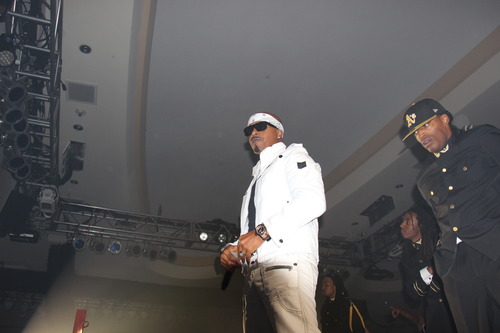
Bowe’s camp had better luck with Holyfield, who was desperate for a shot at winning back his titles. Newman had initial discussions with Holyfield’s representative M.C. Hammer (the rapper, above at Fight Night 2012), before joining Bowe for a world tour that included stops in Africa and the Vatican. Finally, the two agreed to meet on September 10th in Las Vegas (the rematch would actually take place November 6th), with each fighter having a tune-up bout in between, in a city to be determined.
“Atlantic City, Washington, D.C., and believe it or not, Portland, Oregon, are all possibilities,” said Newman. “If it’s Washington, D.C., we’re looking at RFK Stadium as a possibility.”
Portland reportedly offered Newman $1.75 million to host the fight and Atlantic City offered $2.5 million. The D.C. Armory Board, an independent government agency that oversaw the use of the Armory and RFK Stadium until 1994, guaranteed $1.1 million.
“It’s not just a fight, it’s an image-builder for the city,” said George W. Brown, then D.C.’s assistant city administrator for economic development. “We’re going to rock-and-roll this fight like it’s never been done before.”
For Newman and Bowe, the guarantee and the opportunity to fight in D.C. were enough. On March 24, a news conference was held at the L’Enfant Plaza Hotel announcing that Bowe would fight Ferguson on May 22nd at RFK Stadium. The bout would be broadcast on HBO and 30,000 tickets would be available. At the news conference, Mayor Kelly carried a sign reading, “D.C. is a World Championship City.”
There was little excitement about the fight itself. Ferguson had started his career off 13-0, but had gone 6-9 since, with his only quality victory being over Mercer. In April, Newman announced that Jones and Hopkins would fight for the vacant IBF middleweight title, thus making the card stronger.
At the time, the two were just developing into the all-time greats they would later become. Jones was best known for being robbed in a decision for the junior middleweight gold medal at the 1988 Olympics.
“I still would have preferred to have the gold medal that I went for, but in retrospect, it probably got me more attention because people still remember to this day what happened to me,” Jones said at the time.
The story of Hopkins’ rehabilitation as a boxer and his perseverance after his first professional loss became national news. He told the media he knew the fight was the chance of a lifetime and he worked out on the National Mall, where he had one amazing encounter.
“I looked and there [President Bill Clinton] was, coming right at us,” Hopkins said. “He had his hat pulled down, but right away, I knew who it was. It was sort of funny. I’m out with two security guys with walkie-talkies, and he has a guy on either side of him and it looks like they have walkie-talkies. It was like two fighters eye to eye; we’re looking at them and they’re looking at us. Of course, we knew who they were, but they didn’t know who we were.”
Bowe’s training was not going as well. In early May, he had to briefly suspend workouts at his camp at The Homestead resort in Hot Springs, Va., because he was experiencing shortness of breath. Then, one of the five metacarpal bones– which connect fingers to the wrist– in his left hand popped out and had to be reset.
To make matters worse, tickets were selling poorly for the fight. The quality of Bowe’s opponent was certainly a factor, as was the fact that the fight was on a night when many D.C.-area high schools were holding their proms. Additionally, the city experienced a tragedy when beloved longtime city council member and chairman John A. Wilson died days before the fight. Though it’s uncertain whether his death affected tickets sales.
The low attendance prompted writers like Povich to criticize the amount of money the District put up for the fight, saying it could have gone to aid the numerous problems the city was facing at the time. Columnist Michael Wilbon blasted this line of thinking.
“As it is, the $1.1 million guarantee is a nice investment, and it’s what the city will have to do to produce revenue-producing events,” he wrote in a May 22nd Washington Post op-ed. “You know how much Chicago or New York will reap for a week of three NBA Finals games? Millions. This is why cities do whatever is necessary to lure NCAA regionals and sub-regionals, fights, auto races, golf tournaments, NBA and NHL all-star games, and World Cup games.”
Jones’ eccentricities, which many would just call rude, were already showing in the days leading up to the bout. He skipped most of the pre-fight media events, infuriating Newman and Hopkins.
“[Jones] says he’s in Vegas, but the guy could be around the corner,” Hopkins said.
Approximately 9,000 people attended the fight at RFK, thanks in part to Newman giving away free tickets to area youth. As most boxing fans know, Jones had an easy time in his first go-round with Hopkins, dominating the early and late rounds to win a unanimous decision. The final scorecards all read 116-112 in his favor.
“I knew I had to stay inside to negate his power,” Jones said after the fight. “He landed a couple of good shots but didn’t really put anything together and never hurt me.”
Again, Bowe showed up overweight for Ferguson, but it made little difference. The champ sent his over-matched opponent to the canvas at the end of the first round, then swarmed him in the second. Bowe sent Ferguson to the mat again in the opening seconds of Round 2 and referee Larry Hazzard stopped the bout. Of note, this was the first heavyweight championship bout in which all three judges were women.
The final total for paid attendance was 5,581, but a $400,000 investment by Caesars World and Budweiser helped the Armory Board turn a profit of $41,000. Nevertheless, the trying experience, coupled with the Washington Football team’s 1997 move to FedEx Field in Landover, Md., and the decline of stadium fights in the U.S. have all but ensured that we will never see another fight at RFK again.