Mike Reed & Jarrett Hurd Ring In The New Year
Photos by Trey Pollard for StiffJab.com
by Gautham Nagesh
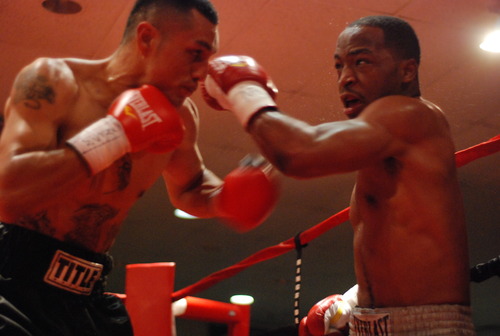
FT. WASHINGTON, Md.–Unbeaten Waldorf boxer Mike Reed (right) began 2014 much the way he ended 2013, when he was named Stiff Jab Prospect of the Year.
Reed stopped Jorge Marquez in the 5th round of a scheduled six to notch the seventh win (5 KOs) of his career at Rosecroft Raceway on Friday night. Accokeek junior middleweight Jarrett Hurd won a split decision over Chris Chatman in the co-feature, improving his record to 11-0 (6 KOs).
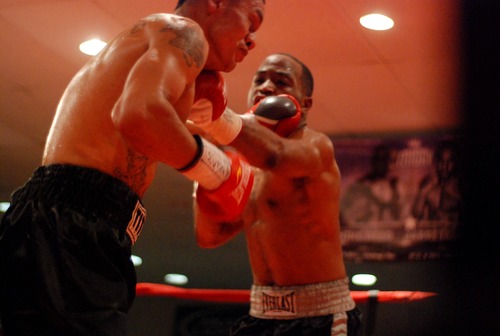
[[MORE]]It was another strong showing from Reed, in another tough fight for the 20-year-old junior welterweight. Marquez came to win and held his ground in the first round, though Reed appeared to have the edge as he jabbed and parried from outside. Reed scored early with a straight left to the body, and then followed with the counter right hook to the head. But Marquez managed to get shots in as well, albeit less frequently.
Marquez began marching forward behind his jab in the second round, applying more pressure to the shorter Reed. Reed responded with a strong combination, but Marquez shrugged it off and fired four punches back in return. As the round continued, both men loss interest in defense. Reed landed the sharper blows, but Marquez fed him right hands with regularity. Marquez probably edged the round, and appeared to be turning the tide.
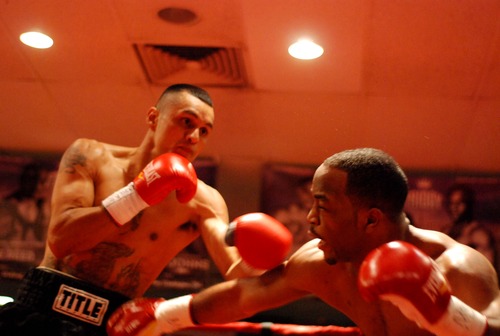
Fortunately for Reed, his father and trainer, Coach Michael “Buck” Pinson knew exactly what to say between rounds. Reed responded by finally moving his head and defending in third. Reed’s ability to control range can only be earned through years inside the ring. He used that range much better in the third round, moving out of reach when he wasn’t planning to throw. When they did get close, Reed fired his shots then tied up or stepped out, avoiding any response from Marquez.
Marquez had his best moment in the 4th round, catching Reed early with a combination that appeared to hurt him briefly. Marquez charged forward, but Reed wisely tied up. The pair separated and began raining bombs on each other, but Reed managed to square things with a pair of left hands to the face of Marquez. Reed regained momentum as the round wore on, and returned to dominating with quick combinations, followed by quicker footwork.
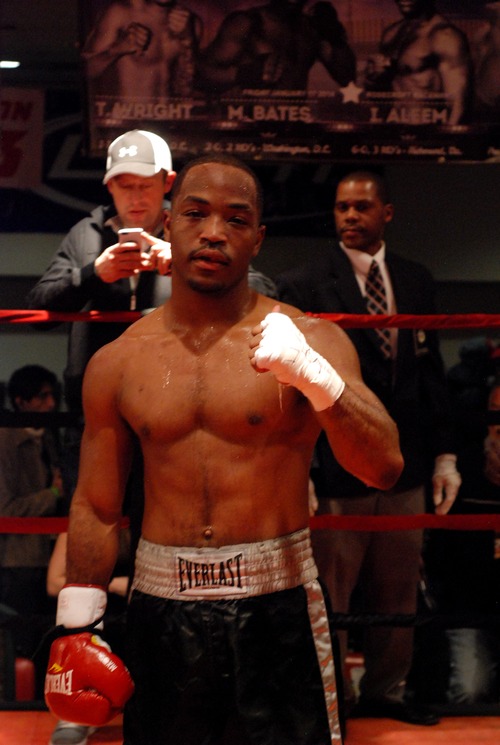
Marquez mounted an attack to start the 5th round, firing a flurry of punches for which Reed had no response. Reed tried to separate himself with his jab, then returned to winging his fast flurries with both hands. Reed uses angles superbly, and has an instinctive sense for when he is in danger. Unfortunately, sometimes he ignores that spider sense to mix it up, the mark of a fan-friendly fighter, but also one that takes more damage than needed.
Reed landed a final combination in the fifth and suddenly Marquez turned away, pointing at his ear in obvious discomfort. Reed sportingly backed off as the ref stepped between them to stop the fight. Marquez quickly consulted the ringside doctor about an apparent injury to his eardrum. The official result was a TKO-5 at 2:34 for Reed, who appeared to be firmly in control when the fight was stopped.
My good friend and colleague Tim Starks sat next to me at ringside, and his report shows he was suitably impressed by Reed’s progress to date. Tim believes Mike should stay at this level and keep learning, which is probably the right advice. Unfortunately, the reality is that Mike needs to sell tickets to keep busy, and finding opponents of this level at an affordable rate will only become harder as his reputation grows.
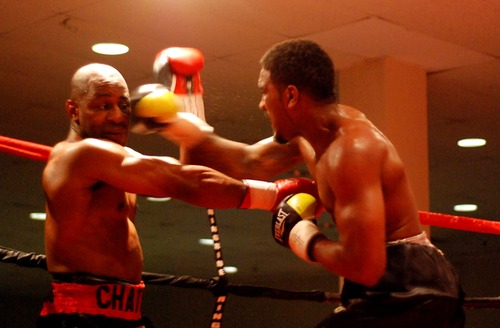
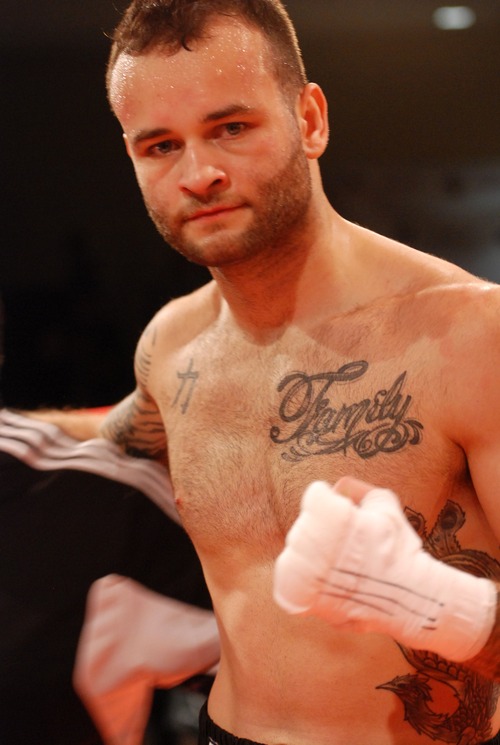
Fortunately Keystone has a slew of Friday Night dates booked this year at Rosecroft, and it’s a good bet that Reed and Hurd (above right) will feature near the top of most of them. Jarrett was his usual solid self against Chatman, who worked hard through the fight but threw slapping, wide punches that did little damage. Hurd does nothing exceptionally well, but his overall package improves every time I’ve seen him fight.
Chatman is an awkward fighter that fights in a herky-jerky style, making his attack difficult to anticipate. When he does unload, he throws short bursts of body shots that sound vicious when they land. He won the first round on my card by repeatedly charging the taller Hurd, and unloading a flurry of punches on the inside.
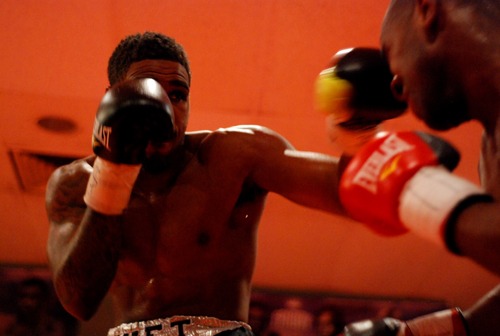
Hurd has been overshadowed locally, a product of fighting around the same weight as blue chip prospects like D’Mitrius Ballard, Antoine Douglas, and David Grayton IV. Hurd may not have the same level of amateur accomplishments as that trio, but as a pro he has been busier and has improved steadily. A tall, smooth boxer with good timing and strength, Hurd tried to stay cool and use his reach advantage on the outside, but early on Chatman was wary of engaging when he wasn’t unloading one of his flurries.
By the end of the first, Hurd began picking his spots better and working his way into the fight. Chatman was ahead, but burning a lot of energy to score points. Chatman somehow kept up the pace in the second round, but his punches appeared to lose some of their steam. Hurd was still unable to make him pay though. One of the local fans behind us offered some helpful advice for Hurd to keep his opponent in punching range.
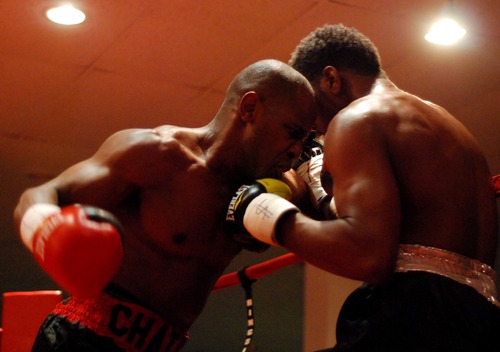
“Step on his foot and catch him with the right hand,” yelled the helpful observer.
Hurd edged the second round for us, but Chatman was pumped up by the prospect of scoring the upset. He danced in his corner to the arena music between rounds, clearly loose and enjoying the fight. Hurd brought him back to reality with an uppercut to the crotch, an obvious low blow that prompted a time-out from the referee. When the action re-started, Chatman continued to drop his head, and Hurd responded by pelting him with uppercuts and hooks to the body.
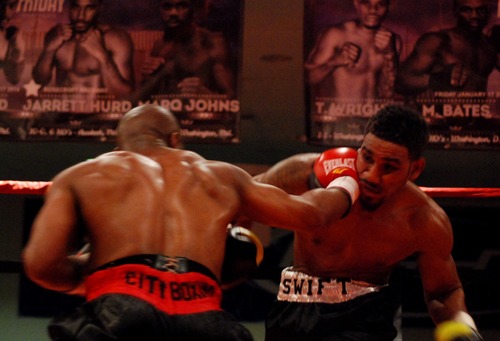
Chatman’s corner spilled their ice bucket on the canvas before the 4th round could star, which was either a strategic masterstroke or simple clumsiness. It helped their man, as Chatman began the round with renewed energy, but Hurd was soon picking him apart again with hard counterpunches. Hurd’s straight right hand was finding a home, but he inexplicably chose not to follow it with a left hook. Had Hurd put his punches together, it appeared he might have a chance at hurting Chatman more severely.
Around then I mentioned to Tim that Hurd may have trouble beating very good fighters, because he’s not exceptionally fast or powerful. But he should also be able to give almost anyone a tough fight, because he’s strong, tall, and has shown mastery of the subtle craft of boxing. Hurd cut the ring off effectively in the 4th round, giving Chatman less time to rest and run away between his bull rushes. Hurd’s approach isn’t spectacular, but it’s designed to get the job done.
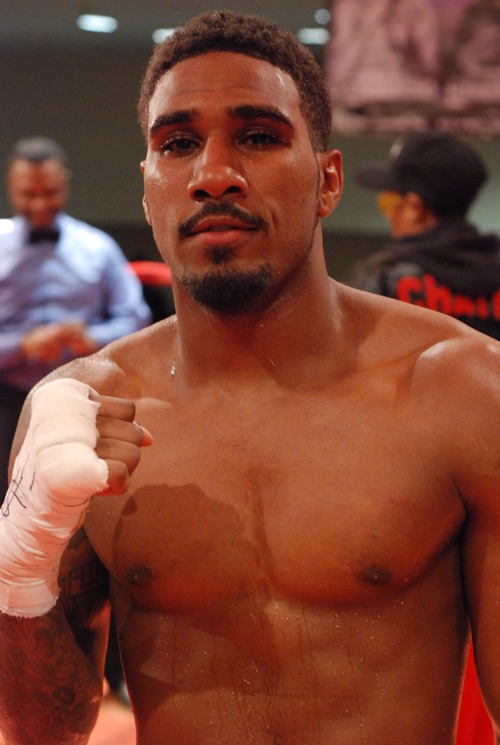
Chatman fought back in the 5th, ending his backward movement and forcing Hurd back into the ropes. Hurd tried to halt his advance with the uppercut to the body, which landed several times before Chatman backed off. Chatman grew more reckless, jumping in from the outside in hopes of landing something dramatic. But when the fighters grew close, they wrestled rather than letting their hands go.
Hurd opened the sixth and final round by smacking Chatman with a right hand, which staggered the San Diego native briefly. The crowd leapt to their seats in hopes Hurd would close the show, but he took his foot off the gas and spent the rest of the round coasting to victory. That decision was one of the few signs of immaturity to date from Hurd, and gave Chatman enough hope to raise his hands in mock celebration as the final seconds ticked down.
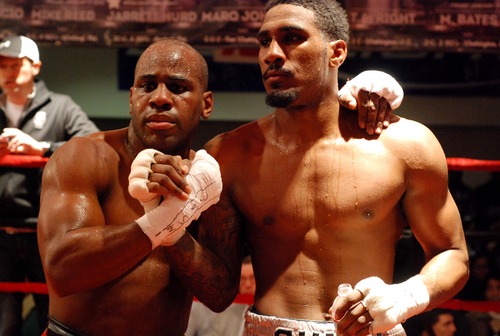
What we viewed as a clear decision for Hurd turned out to be not so straightforward, thanks Judge John Gradowski, who somehow scored all but one round for Chatman. Chatman was busier, and may deserve more credit than we gave him, but it’s ridiculous to argue he was the more effective puncher in five out of the six rounds. Fortunately the other two judges scored it for Hurd, awarding him the split decision victory.
Afterward, the local fight fans were treated to the unusual scene of the visitor and loser addressing the crowd, but not the winner.
“It is what it is. I doubt I get a rematch, but I felt I won,” Chatman said to some cheers. “Hurd, I’m calling you out.
Chatman also thanked the audience, then became approximately the millionth person in boxing to blame poor judging for the sport’s demise.
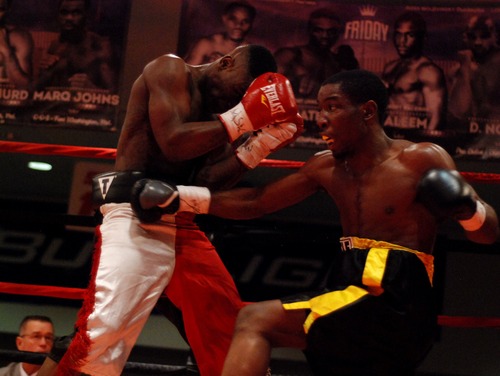
The top two bouts were a welcome sight after a mostly pedestrian undercard. The best of the early fights matched Marcus Bates (red and white trunks) of D.C. against Stephon McIntyre (black and yellow trunks) of Georgia and was supposed to take place at 119 lbs.
I’ve seen Bates fight before, and have been impressed by his combination of natural talent and athleticism. Unfortunately, other aspects of the sport have been a challenge for him. He came in a massive five pounds over the contracted weight for this fight. To his credit, McIntyre chose to fight Bates anyhow, and it was a good decision.
Bates has wonderful balance, and transitions seamlessly from offense to defense. But one wonders if he is really listening to his coaches at Old School Boxing when it comes to the finer points of the Sweet Science. Bates fights with his hands held directly below his chin, where they offer neither protection nor the ability to parry his opponent’s blows. He marches forward without using his jab or head movement, making him a sitting duck for his opponent. And yet when Bates decides to punch, it’s often explosive.
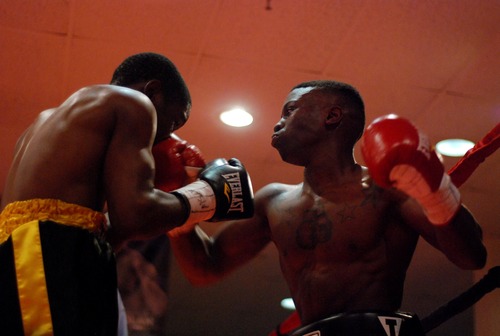
McIntyre was unimpressed. He kept peppering Bates with shots as the latter moved forward, and eventually put the hometown fighter down with a clubbing right hand at the end of round 2. Bates sprang up, relatively unscathed, and started fighting with renewed urgency over the final two rounds. He trapped McIntyre against the ropes in the third, and rocked him with a steady stream of punches. But McIntyre escaped the round upright.
Bates tried to walk his opponent down in the 4th, but his refusal to jab or move his head made him a ripe target for McIntyre’s jab on the way in. McIntyre tried to keep Bates out with the jab, then smother him when the two got close enough to punch. Despite those effective tactics, Bates still managed to rock McIntyre again near the end of the round. Bates had his opponent hurt, but not hurt enough to go down. It looked like his third fight would result in his first loss, against an opponent with far fewer gifts.
Luckily for Bates, the judges didn’t quite see it that way. One had McIntyre winning by a point, but the other two scored it 38-38, resulting in a majority draw. Bates is not known for his focus in the gym, but perhaps this is the wakeup call he needed. I have little doubt that he could be a very good fighter if he committed himself to the sport.
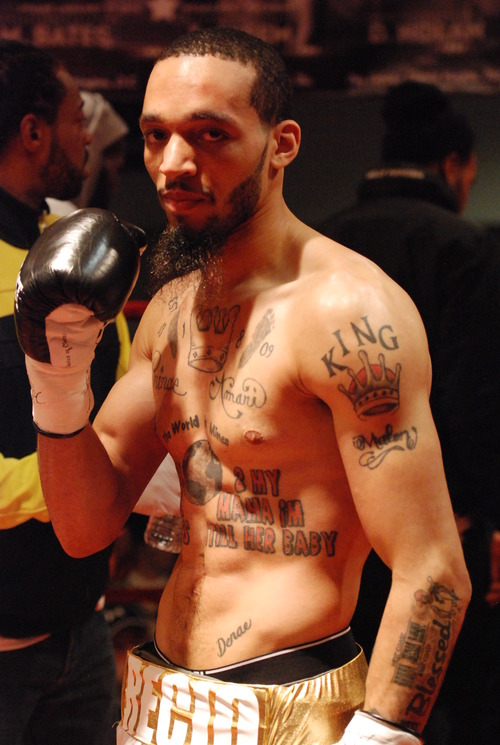
Springdale junior middleweight Larry Recio needed just 44 seconds to finish debutante Malcolm Green, the latest North Carolina fighter trucked up to the nation’s capital for the purpose of getting knocked out. Recio’s ring attire of white trunks with gold trim, white socks and black shores was pretty hideous. The right cross he landed on Green following a wide left hook, on the other hand, was a thing of beauty. Green tumbled through the ropes, with no shot of getting up and continuing.
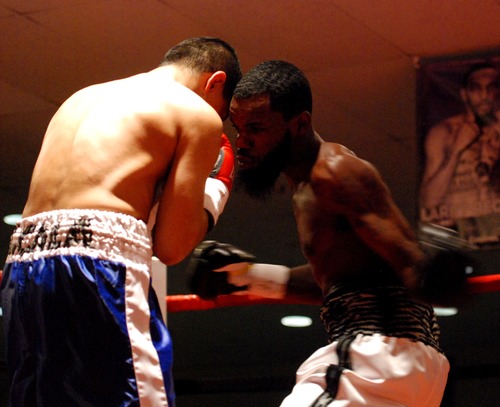
Super bantamweight Marq Johns (right) scored his first professional win over Carlos Alcala on the undercard, after drawing with McIntyre here in his pro debut last month. Both of the fighters are tall and stringy for the weight class. Johns throws punches in bunches, landing several at a time. Alcala’s style is a little sloppier, but his punches are straighter.
Alcala has fought four times as a professional, all of them in Southern Maryland. He has been stopped by a local prospect every time. Alcala’s name was written on the back of his trunks in black permanent market rather than being printed. Yet he did not fight like someone here simply to lose.
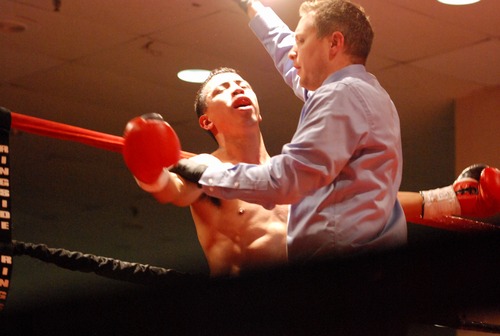
Johns trapped Alcala against the ropes in the second round, and started working him over with punches to the head and body. Alcala might have been hurt, but it did not look serious, and he took far more damage in losses to Bates and Kevin Rivers Jr. Nevertheless, the ref stepped in and stopped the fight, much to the displeasure of Alcala, who looked able to continue. The fans weren’t shy about expressing their frustration either.
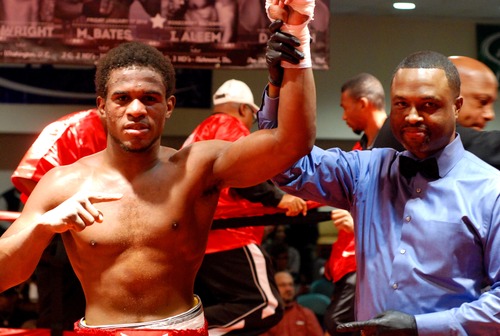
The second bout of the night was between Richmond, Va. super middleweight Immanuwel Aleem (above) and Timothy Hall Jr. of Athens, Ga. Aleem controlled the first round from the outside, but Hall managed to land a few well-placed shots of his own, including an overhand right. Aleem is somewhat quick but small for 168 lbs., and doesn’t possess dynamic power. It will be tough for him to compete at a higher level unless he moves down to middleweight.
Hall did better in the 2nd, while Aleem tried to box more and relied almost completely on his jab and left hook. His refusal to use his right hand gave Hall more courage, and Hall responded by stalking Aleem in the third round while throwing hard combinations to Immanuwel’s head and body. Aleem stood his ground and fired back in the third, as the action and crowd both finally warmed up.
Both men were tired in the 4th, but kept trading hard shots in the middle of the ring. Aleem seemed to be getting stronger, while Hall appeared to fade. Aleem doubled the left hook to Hall’s head and body, which took its desired effect by slowing Hall down. It was more of the same in the 5th, as Aleem pounded Hall with left hooks and the occasional right hand.
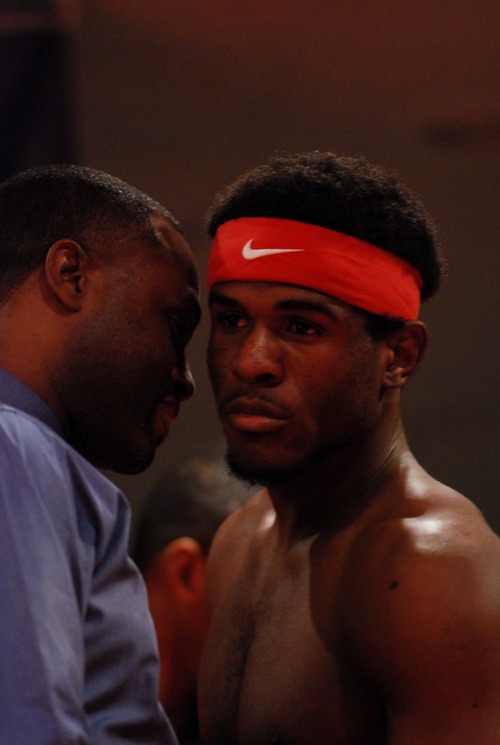
That Hall managed to stay upright amid the raining blows is a credit to his professionalism. His corner pleaded with Hall for a five-punch combination in the 5th round, and somehow he responded. But Aleem blocked most of the shots and then fired back himself. Hall managed to rally slightly towards the end of the 5th, but the round still went to Aleem on our card.
Aleem’s steady body attack paid dividends in the 6th and final round, as Hall appeared more concerned with guarding his liver than his chin. Aleem kept firing hooks downstairs, but never managed to include the kill shot to the face that would have made this a memorable result. Aleem scored with an uppercut-right hand combination late in the round, before Hall tried to fire back with one last stand. Aleem weathered the storm, and the two traded blows until the final bell. The final scorecards were clearly for Aleem, but Hall acquitted himself well.
The evening’s opening bout saw an upset, as light heavyweight P.J. Cajigas stopped the muscular debutante Dimitrius Nolan of Capitol Heights in the first round. Cajigas hurt Nolan with a series of blows late in the first round, including an uppercut to the midsection. Nolan looked to be out on his feet when the last two shots landed, sending him crashing to the mat. He remained there well after the bell, thanks to the wisdom of the referee and ringside doctor.
It was the first win as a for Cajigas (below) in five professional fights. He previously lost to local prospects Greg Newby and Devar Ferhadi.